Case study · Creative development
A house you can scroll through.
Role
Concept, art direction, 3D, development
Stack
Next.js App Router, React, TypeScript, Tailwind, GSAP, Lenis, Three.js, React Three Fiber
Scope
A 9-chapter scroll film, property platform, forms and this write-up
Status
Portfolio project. AURELIA and its residences are fictional.
01 · Creative concept
The house is the protagonist.
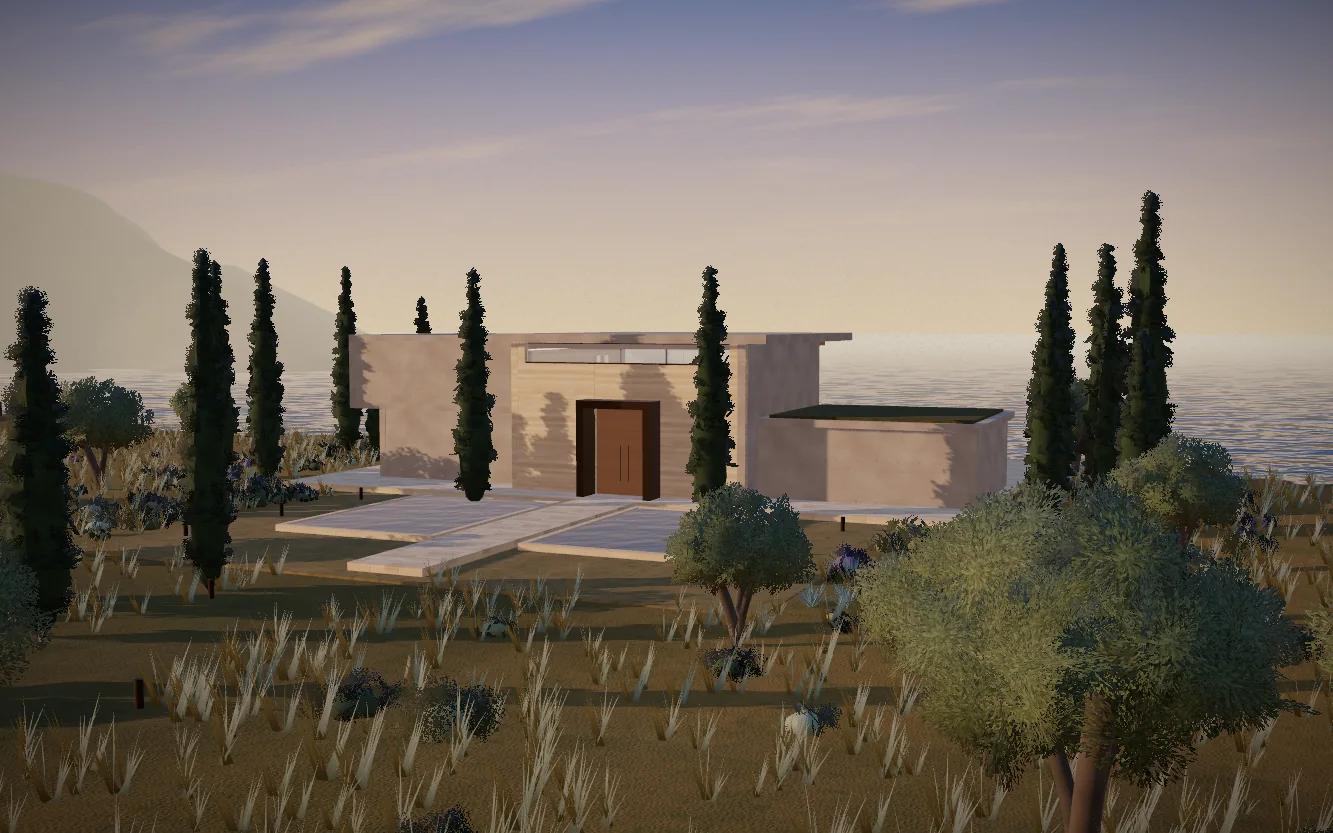
The brief was not a real estate site with animation. It was an architectural film the visitor directs by scrolling: one house, one continuous camera move, from the olive grove to the sea and up into the sky.
Everything follows from that. A single flagship residence carries the homepage; the camera never cuts; the light changes because time passes, not because a section ends. The rest of the platform (collection, detail pages, viewings) is deliberately calm editorial print, so the film has somewhere to land.
02 · Visual direction
Editorial restraint.
Six colours, used sparingly: obsidian and warm ivory for most surfaces, soft stone and architectural grey for structure, champagne gold only for index numbers and hairlines, deep forest for upholstery and hover fills. Type is Instrument Serif set large, tight and uppercase, with italics reserved for a single emotional word per headline, against Manrope for body copy and wide-tracked labels.
There are no rounded cards. Information sits on hairlines and in typographic ledgers; images carry their captions underneath, like plates in a monograph.
03 · Technical architecture
Four layers, one clock.
- Story state (
lib/story/state.ts): a plain mutable object holding camera index, door positions, time of day, clay amount, explode offsets. Outside React, so 60 updates a second never cause a render. - Choreography (
lib/story/timeline.ts): one GSAP timeline, scrubbed by one ScrollTrigger, writes that state and drives all chapter typography. Time is measured in screens of scroll: the film is 17.6 screens long. - Scene (
components/three): React Three Fiber components read the state inuseFrame. A camera rig, an atmosphere/lighting system, terrain, vegetation and the residence are independent modules. - DOM layer: every chapter is semantic HTML in a sticky viewport over the canvas, so the story is crawlable and readable without WebGL.
Lenis owns scrolling, GSAP's ticker drives Lenis, and Lenis updates ScrollTrigger: a single clock, so the scrubbed scene never drifts from the scroll position.
instance.on("scroll", ScrollTrigger.update);
gsap.ticker.add((time) => instance.raf(time * 1000));
gsap.ticker.lagSmoothing(0);
04 · Scroll storytelling
Shots, not sections.
The camera path is 24 physical keyframes in world metres, joined by centripetal Catmull-Rom splines for position and point of interest. Index-uniform parameterisation means the timeline can address shots directly: tweening cam from 4 to 5 is “from the bronze portal into the hall”.
Within that, eases do the directing: sine in-outs while walking, long power-two settles when the camera stops on a surface in the materials chapter, a linear sweep for the model orbit. A low-amplitude handheld drift and eased pointer parallax keep the camera feeling operated.
05 · GSAP engineering
Reversible by default.
Every tween in the master timeline is a fromTo with immediateRender: false, so scrubbing backwards through any chapter restores exactly the previous state: doors close, the sun comes back up, the model reassembles. Chapter text uses masked line reveals; the hero headline separates horizontally as the camera starts to move.
cam(3, 4, 2.3, 0.5, "sine.inOut");               // to the portal
val("frontDoor", 0, 1, 2.15, 0.75, "power2.inOut"); // doors pivot inward
cam(4, 5, 2.8, 0.6, "sine.inOut");               // through, into the hall
val("exposure", 1, 1.32, 2.75, 0.6);             // the eye adapts indoors
Everything is created inside gsap.context() and reverted on unmount; the renderer itself is paused (frameloop="never") whenever the editorial sections cover the canvas, and resumes for the closing night shot.
06 · Three.js implementation
One uniform, a thousand materials.
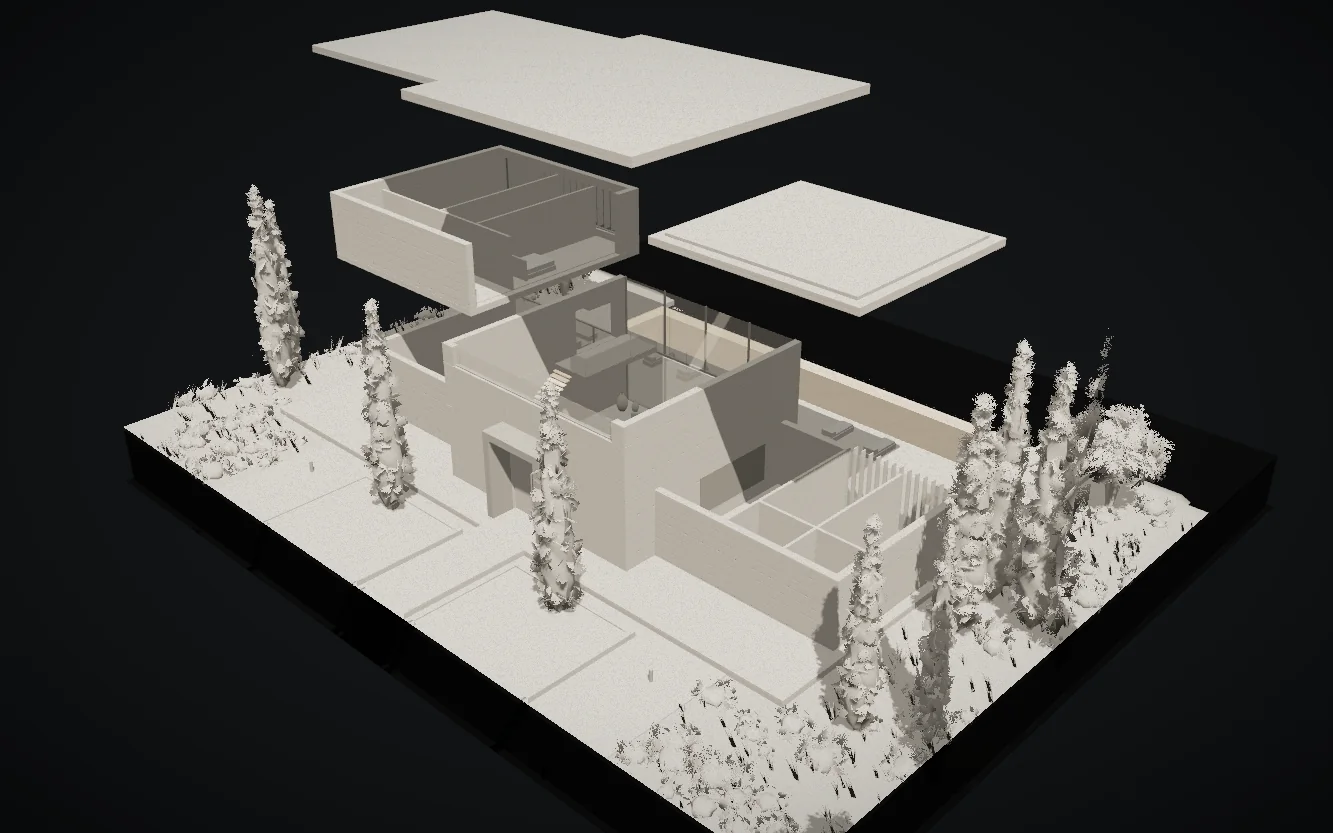
The site never swaps models. Every built-in PBR material is patched through onBeforeCompile with a shared set of uniforms. Animating one of them turns the photoreal house into a white architectural model; another cuts the landscape down to a site plinth; a third tints the stair and pool gold for the exploded view.
.replace("#include <color_fragment>", `#include <color_fragment>
  diffuseColor.rgb = mix(diffuseColor.rgb, uClayColor, uClay);`)
.replace("#include <clipping_planes_fragment>", `...
  vec2 d = abs(vAurWorld.xz - uSiteCenter) - (uSiteHalf + grow);
  if (max(d.x, d.y) > 0.0) discard;`)
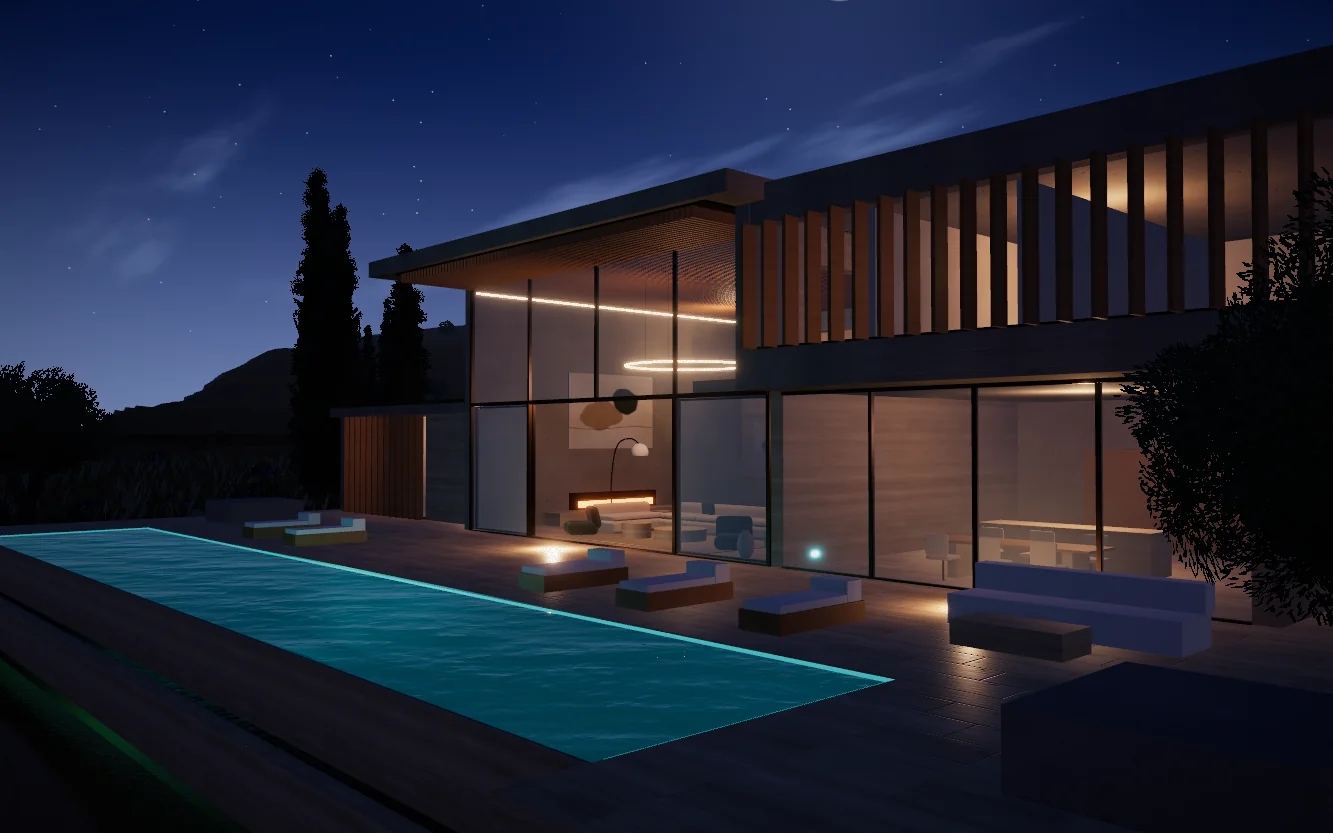
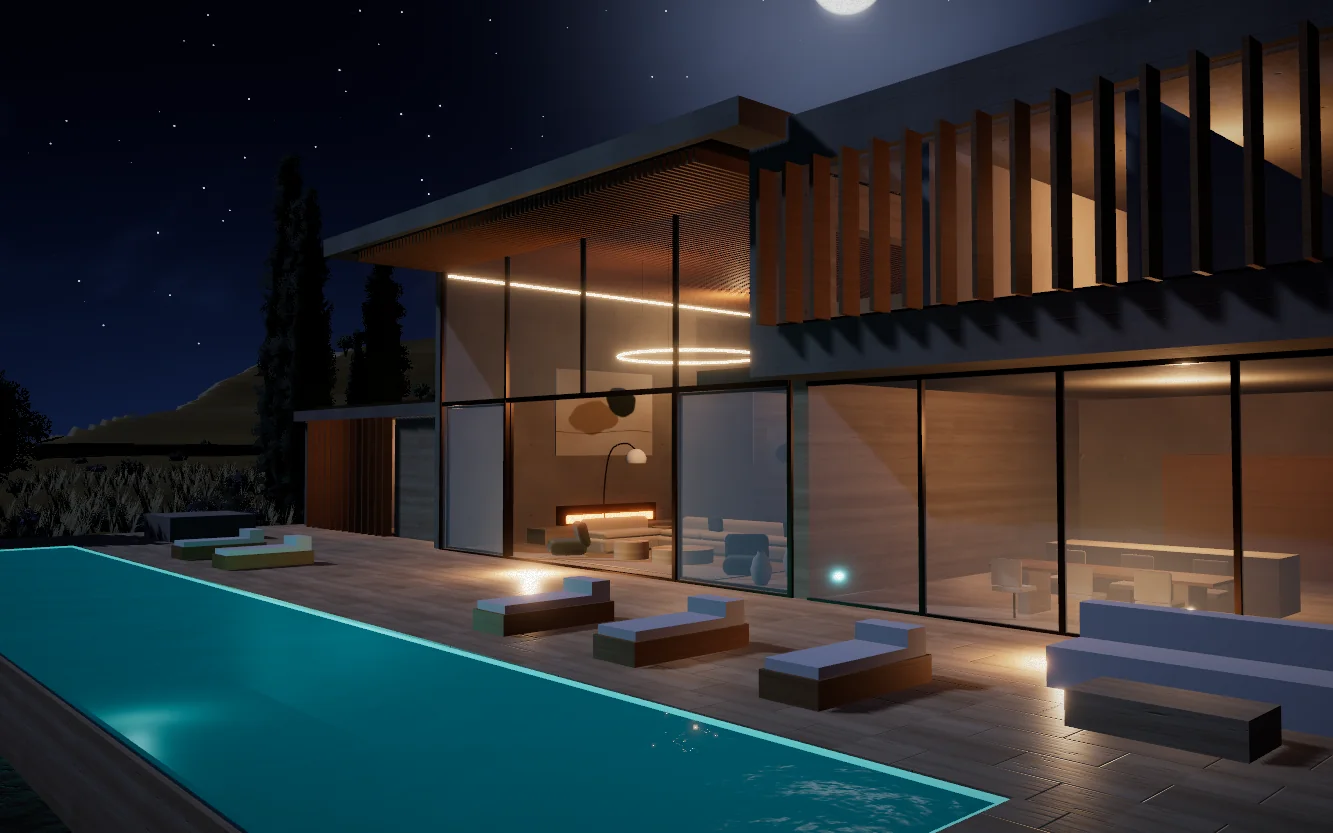
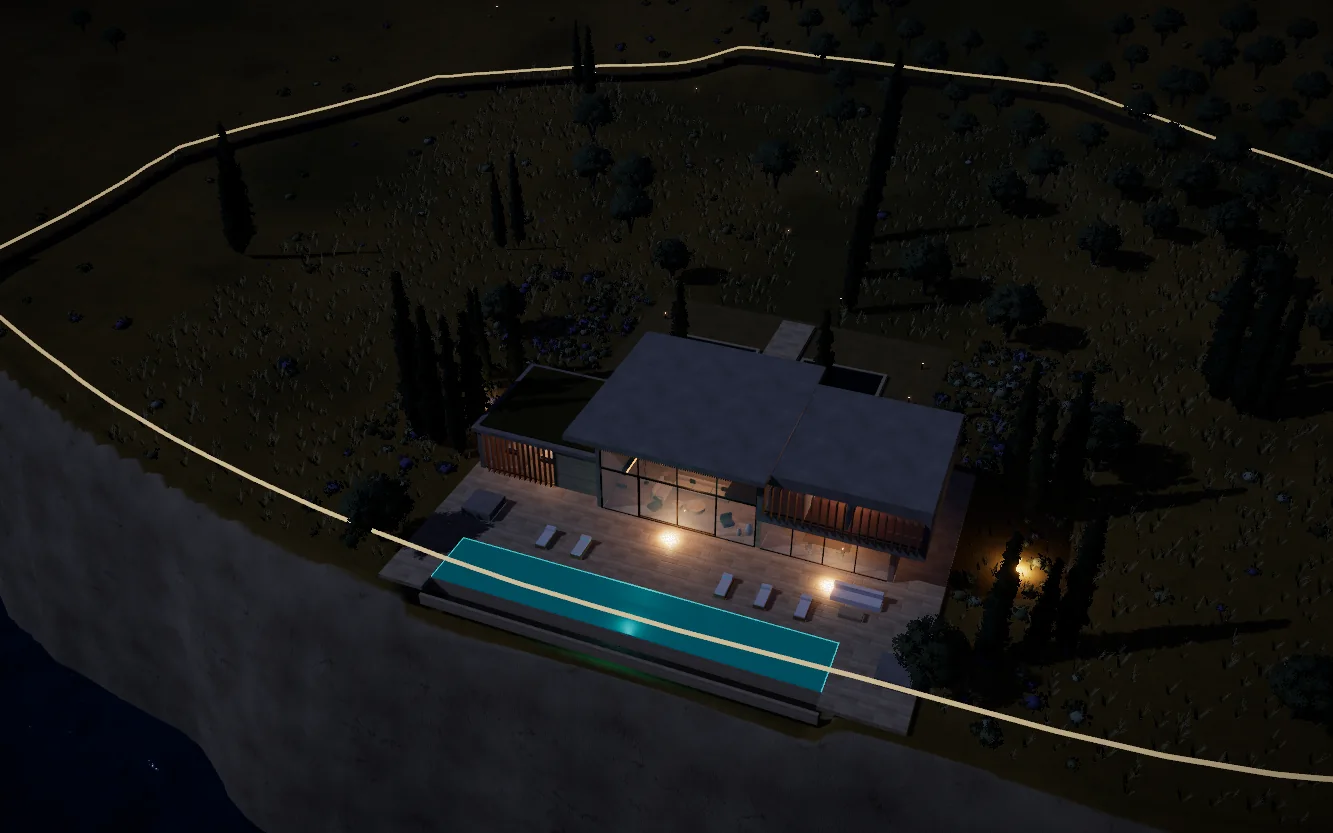
The day-to-night sequence is a lighting model, not an overlay: sun direction, colour and intensity, sky light, a procedural sky shader with sun disc, cirrus, stars and moon, fog, image-based lighting regenerated through PMREM from that sky, and interior, pool and landscape practicals are all keyed to one value.
07 · Architectural scene
Drawn in metres.
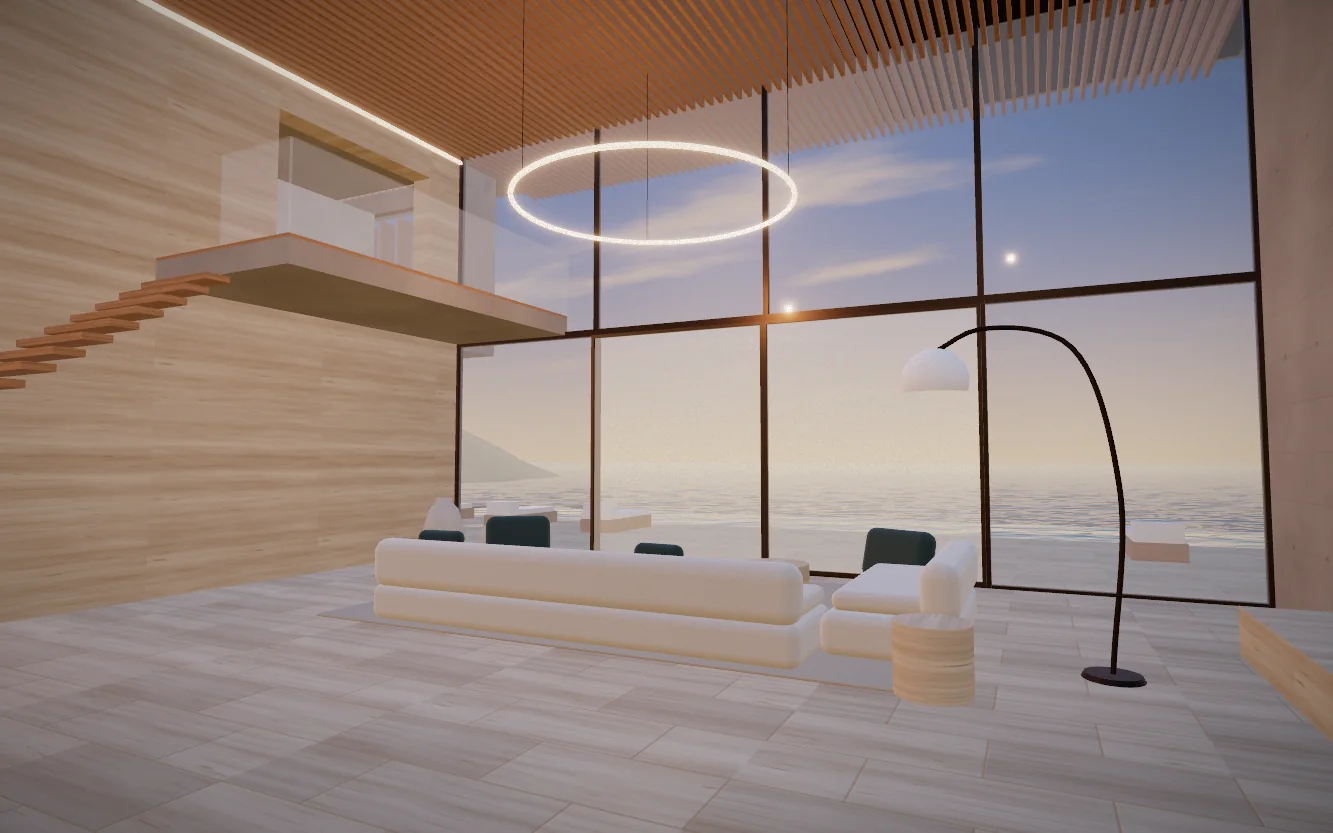
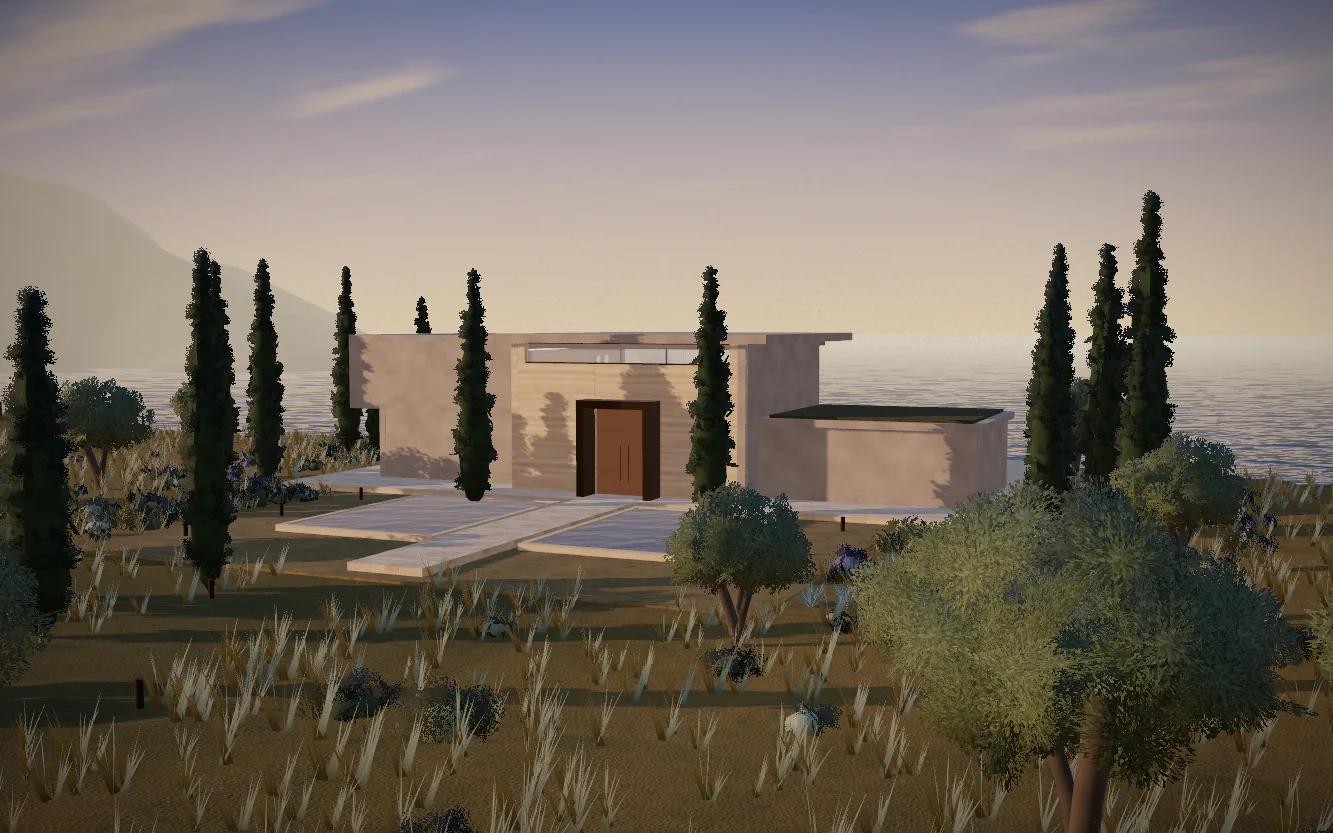
The Solstice Residence is authored as a plan in code: about 240 extents for walls, slabs, glazing and joinery, each tagged with a material and an explode group (ground, upper, roof). They are merged per group and material into a handful of draw calls. UVs are generated in metres, so a texture keeps its real-world scale on every surface.
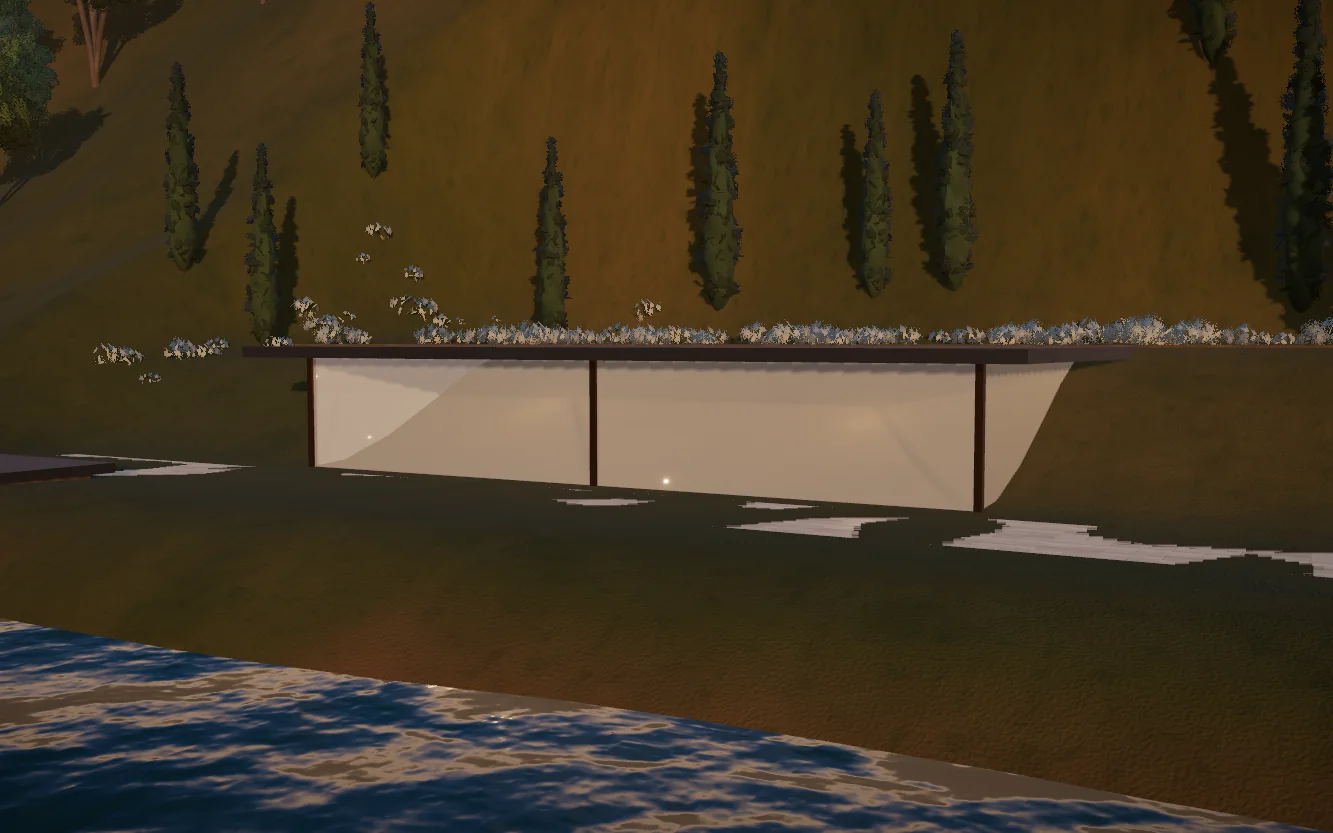
The headland is a height field with a cliff that recedes on both sides, a flattened building platform, an excavated pool basin and a road bed graded along the access road. Planting is rule-based and seeded: cypress allées on the drive, an olive grove terraced across the slope, shrubs and grasses that soften the podium, all instanced with alpha-card canopies and vertex wind.
08 · Asset strategy
Nothing borrowed.
Real-time 3D only convinces if every image of the house agrees. So there is no stock photography anywhere on the site. Every image, including the collection's photography and the fallback film, is rendered from the site's own scenes through an internal /studio route and a Playwright pipeline (scripts/render-stills.py).
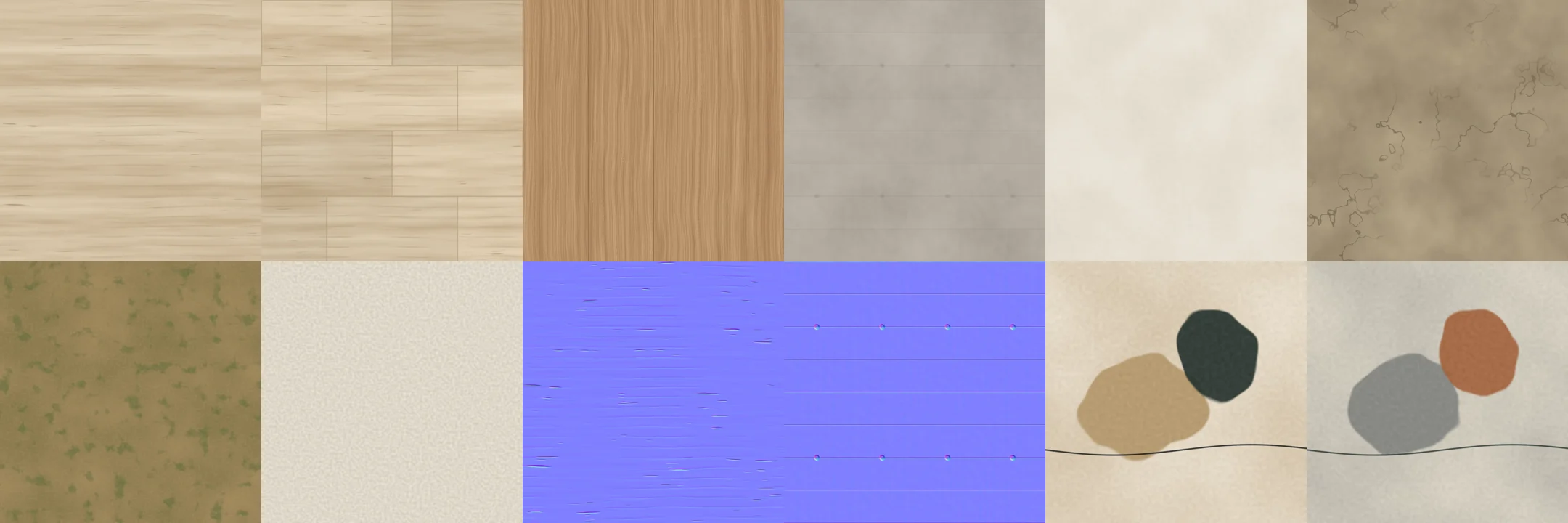
Textures are generated procedurally from seeded, tileable noise (scripts/generate-textures.mjs): travertine, rift-sawn oak, board-formed concrete, lime plaster, rock, dry ground and boucle, each with albedo, normal and roughness maps. Foliage atlases are drawn as SVG and rasterised. The only third-party asset is the three.js water normal map (MIT). Sources and licences are listed in ASSETS.md.

Honest limits: the five collection residences are simpler scenes than the Solstice (exteriors only, box-based architecture), and procedural trees are stylised rather than photo-scanned. A production version would replace them with a modelled asset set or a pre-rendered camera sequence.
09 · Responsive design
Same film, re-framed.
Keyframes can carry portrait overrides, and the rig widens the lens on tall screens so the architecture stays composed on a phone. A capability profile (viewport, pointer, device memory, cores) selects one of three tiers: high (shadows, post-processing, full planting), medium (lighter shadows and effects) and low (no shadows or post-processing, a third of the vegetation, fewer lights, lower terrain resolution).
Without WebGL, or with prefers-reduced-motion, the homepage becomes a sequence of full-bleed stills of the same scene with the same copy, and a lost WebGL context falls back to it at runtime.
10 · Performance
Spend where it shows.
- Static architecture merged by material; vegetation fully instanced.
- The shadow map re-renders only when something that casts a shadow changes (sun, doors, explode), not every frame.
- Image-based lighting is regenerated only when the time of day moves by a perceptible step.
- The canvas stops rendering entirely while editorial sections cover it.
- The 3D stage is a dynamic import, never server-rendered; device pixel ratio is capped per tier and adapts on lower tiers.
- Geometry, materials and textures are disposed on unmount; GSAP contexts are reverted.
No frame-rate figures are quoted here: they depend on the device, and none were measured on real hardware for this write-up.
11 · Challenges
What was hard.
- Infinity edge that meets the horizon
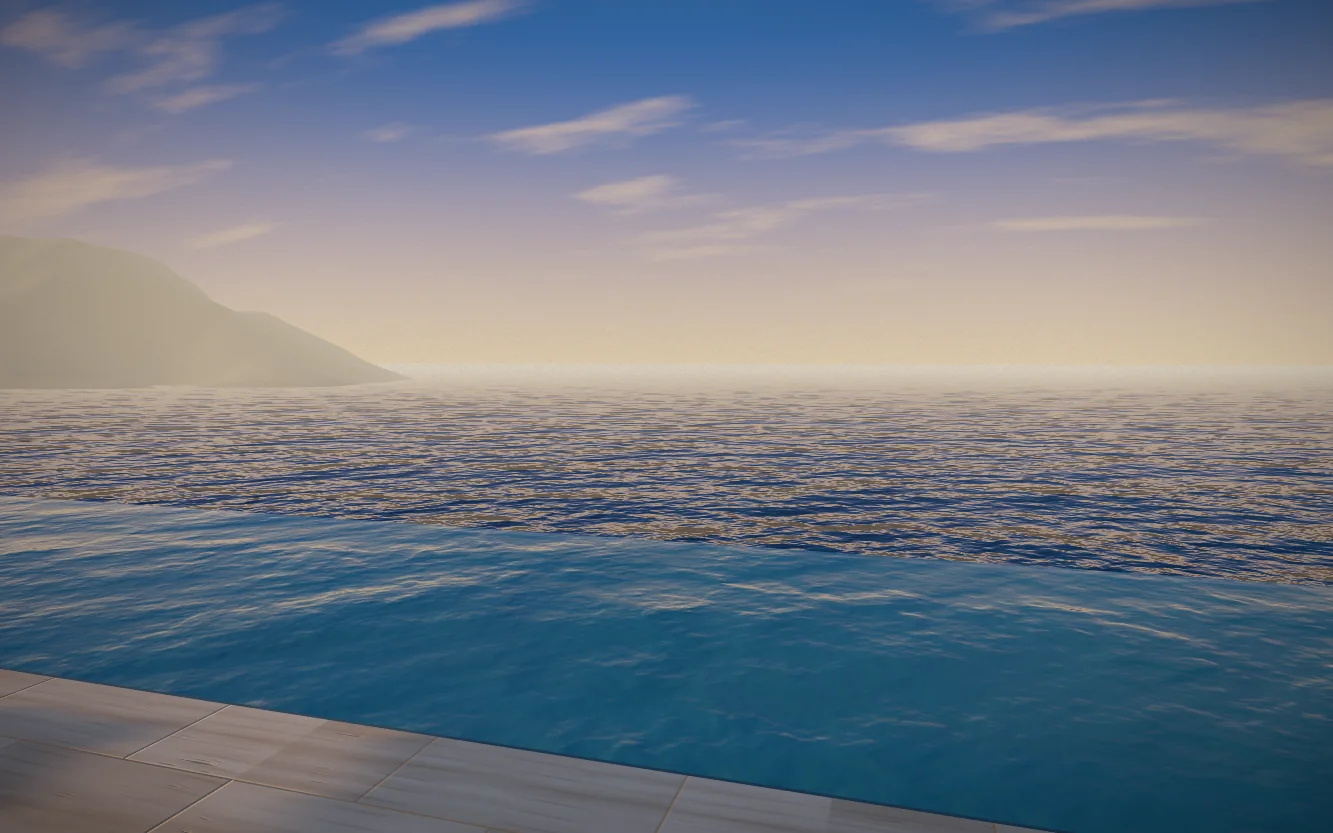
- From a terrace camera the pool edge sits about 13° below the horizon, so the garden between pool and cliff showed above it. The fix was architectural: move the pool to the cliff lip so the land falls away below the weir.
- Light from below the horizon
- At blue hour the sun is below the horizon, but a directional light there lights the undersides of everything. The light's elevation is clamped while the sky keeps the true sun position.
- Foliage that doesn't look like rocks
- Displaced spheres read as boulders. Alpha cards with normals bent radially outward light as soft crowns while keeping broken silhouettes; back-face normals are left unflipped so crowns don't darken on one side.
- Text over a moving image
- Copy sits on soft scrims and a faint shadow, and each chapter's layout is placed where its shot is quietest.